

Photos by GEN Europe (Kevin Jordan and Daisy Hannah Hunter)
The article was originally published in Slovenian in Jana magazine on 5 November 2024.
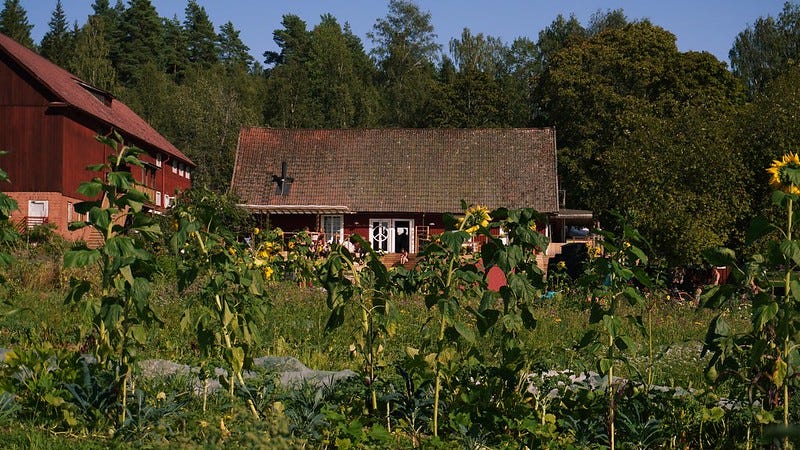
Anna Björkman is the personification of the quote: “When you have more than you need, make a longer table, not a higher fence.” While working in the Middle East, she got used to all their hospitality and when she returned to Sweden, she bought a studio apartment and knocked down a wall to make way for a large table with twelve chairs. This same table is still the center of a community at her new home.
Although I’m an advocate of sitting on the floor to eat, I enjoy writing about community at the kitchen table. If I expect someone to make a step toward me, I must make a step toward them—and my first step is to sit down at the kitchen table and talk about them over a meal, not about myself.
This is exactly the approach that Anna and her husband Dougald Hine cultivate in the long-abandoned shoe store that they bought in the town of Östervåla. The house is more than big enough for two people and a child but the idea was to serve as a place for a wider community to socialize. The story is beautifully presented in the ten-minute film The Shoe Shop.
Dougald quotes Ivan Illich that the limit of today's political possibilities is the number of people who can easily sit at the same table and share a meal. For me, the key word in this sentence is ‘easily’ because many find it difficult to sit at the same table with those who think differently. If we can easily sit down to a meal with people of very different minds, that’s when we expand the field of political possibilities.
Meetings differences—and realities
Anna and Dougald speak about the excitement when an honest exchange of opposing views takes place. If we don't try to understand others, why should we expect them to understand us? Anna has many good experiences in crisis zones, including in Gaza and Israel. In Sweden, she wasn’t comfortable with observing how people avoid each other and maintain a kind of superficial friendliness. Thus began the story of the kitchen table.
John Stewart Mill famously said that he who understands only his side of the argument understands little of that. But we find it difficult to immerse ourselves into arguments that seem untrue.
Dougald told the story of how he got into a conversation with an influencer from a think tank. Dougald believed that the cultural logic of progress was a prison for the imagination and that we needed better stories to free us from the one and only exalted story of progress. The influencer was confused because to him progress was not a story but a fact. Dougald emphasized that, of course, facts exist but many stories are omitted. His interlocutor didn’t want to hear about it, so they looked for something they could agree upon. They ended up agreeing that it’s good that everyone no longer has to work on the land.
They would probably also agree that most of us eat several meals a day and that we can sit at different tables, not just the one at home. The culture of inviting neighbors over for a meal is a powerful tool. One day the neighbors will invite us too. Political action begins at the level of relationships with neighbors, whom we learn to trust regardless of our differences. If we start at the kitchen table, we sow the seeds of something bigger that can later grow into a movement.
In every crisis, neighbors are the first to come to help, not airplanes with human aid. Sitting down with others at the same table means looking closer to the ground and creating a living culture right here. It is also an act of humbly accepting our position in the ecosystem, as we can sit down to a meal only because someone grows food for us.
Fake it at first, arrive in sincerity
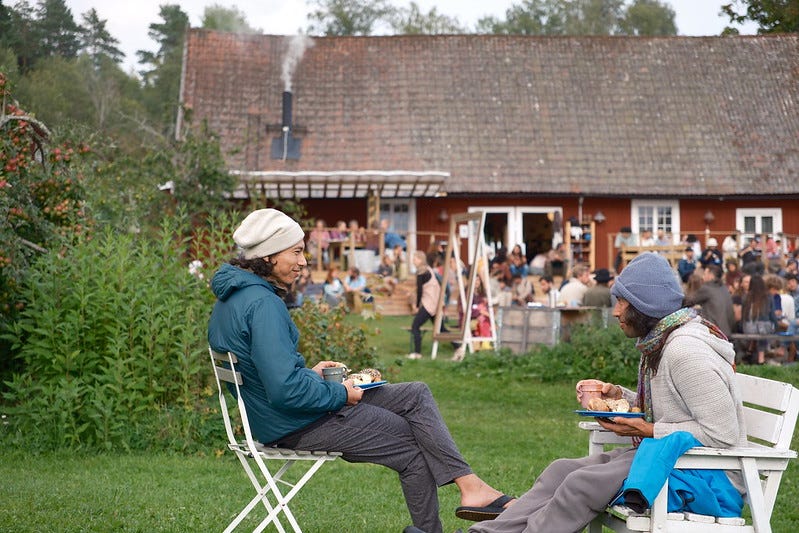
Anna smiled answering the question of how to begin sharing meals. The first time can be awkward, everyone is embarrassed, no one knows how to behave. One has to find excuses to open up to chance, to engage in a conversation with a stranger and discover any connections along the way. As we open one door, slowly new doors begin to open.
After a meal, it is fun to move to the sofa in the living room and listen to a concert, a demonstration of a local craft, a show, or an exchange of funny stories. This is how people have formed community throughout history. It starts with forced kindness, but gradually we find humanity in shared ideas and allow ourselves sincerity, which ultimately transforms us into better versions of ourselves.
It’s special to connect with neighbors with whom we should have nothing in common at first glance. Such bridges do more to expand political possibilities than stern (one-)party meetings.
From farm to fork in practice
Strengthening local communities is most effective with food at the center—from production to sales and meals. People are best connected in those communities where everyone is involved a bit at all levels: where they dedicate at least a day or two to planting lettuce, harvesting carrots, picking olives… they come to the local market and know at least some sellers… they help some evenings to do the dishes or serve guests at a community event.
Maybe it’s good that not all of us have to work on the land, but it’s not good if we have no idea what that work entails. Of course, it is easiest to start building community with a celebration around the kitchen table, but this can be a good incentive for a farmer to invite guests to help her on her field and the socializing may continue actively during the weekend.
Such activism makes the invisible visible. It indirectly removes the mask from the global economy and makes ties where this economy does not want them. The global economy attaches individuals and companies directly to its gigantic mechanisms and makes sure that key phases of production remain strictly separated. To see all the stages of making a mobile phone, you would have to travel the whole world and force open many doors to see the dirty business that goes on behind them. Globalized food is no different, and it’s very difficult to change that with anti-globalization protests.
However, we can put limits on industrial agriculture by inviting the neighbors to dinner and then allowing the farmer to invite us all to her farm. Then we can include all the other elements of self-supply between the first and the last—between the farm and the fork.
REKO rings
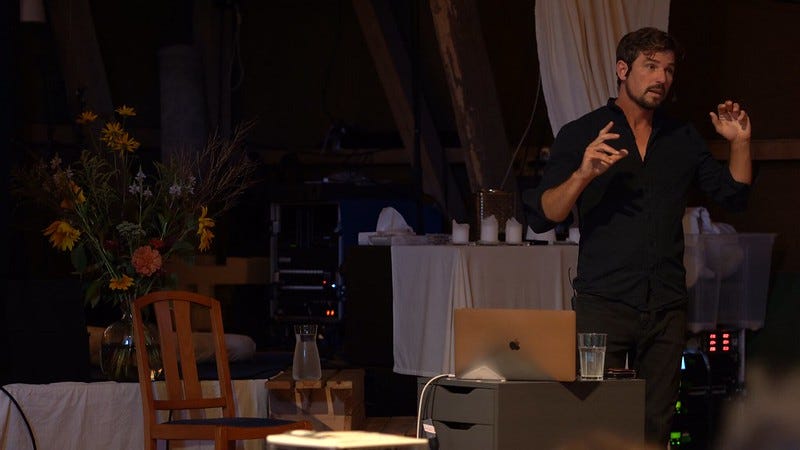
Richard Perkins is a farmer who likes to open the doors of his farm to his customers to get the experience of the entire production. The act of keeping his doors open is his only organic “certificate”. He can afford this because he sells all his produce without intermediaries and he does not want to meddle with expensive bureaucratic processes but, instead, builds transparent connections with his clients, fostering trust.
Richard is convinced that selling produce directly is the future of flexible agriculture. Since the introduction of Internet platforms that connect customers with growers, the life of farmers has become a lot easier. REKO rings are popular, independent pre-sale markets of local suppliers and consumers, active in Scandinavia.
REKO ring can be a Facebook group managed by local growers. Together they set standards and rules and invite customers. Customers receive a weekly notification of what is available and at what prices, book an order and receive a link to pay their order in advance. They come to collect their order at the pre-agreed short-term market, sometimes organized at a parking lot near a cafe, because people enjoy a coffee after the market and the café-owner is happy as well. In about an hour, the market is over and the farmers can go back to work.
A REKO ring gets more popular and successful if the providers are diverse, offering breads, pastries, vegetables, fruit, eggs, meat… In Scandinavia, finances are highly regulated, so advance payment is even better for farmers, because they don’t need to deal with cash and receipts.
REKO rings started by innovators, but as they gained traction, more traditional, initially skeptical sellers joined in as well. New customers get drawn in mostly by word of mouth from satisfied customers. Richard thinks that eye contact and close relationship are the basis of food security.
From snout to tail
Taking care of this basis can ensure responsible consumption. When customers know the entire process of food production, they feel greater respect and care. Richard unapologetically advocates meat eating because animals drive food cycles and the ecosystem simply cannot do without them. The general public is naïve about the vulnerabilities of food production systems—from ecosystem conditions to farm economics—and unaware of the conditions for truly regenerative farming.
Even though I'm predominantly vegetarian, I don't mind Richard's statement at all, because he shows with the results of his work that he knows what he's talking about. Let me add another one of his statements that hit the nail on its head: “If you don't produce food, no one cares what you say about food production.” Richard produces food to feed people, so I keep my mouth shut and I listen to what he has to say.
I was glad to hear about the responsible consumption of beef by eating the entire animal, from snout to tail. Richard calls this anatomically correct eating and also teaches it. He thinks that celebrity chefs should talk about it more. There are parts of animals that are suitable for stews and soups, not everything is filet mignon. There is an imbalance in poultry farming, because everyone would like to eat chickens, that’s why farmers mostly raise chickens, but in many cases, it would be more convenient to raise geese. However, few people want to eat goose meet.
Richard is an old-fashioned farmer in his way, as the bulk of his diet is what he produces. He is not like his neighbor who keeps dairy cows but drinks his coffee with milk from the store. I realized that Richard and his neighbor might need to eat many meals at the same table to get closer to each other and bridge their differences.
Free range people
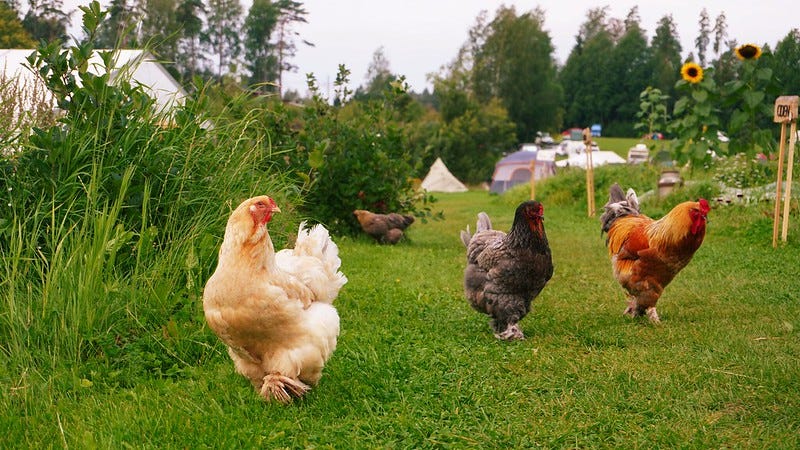
It's nice to see cows and chickens roaming freely in the meadows. And a goose in between. Let alone when barefoot children run along the edge of the forest not far away. And some parents too.
It makes sense to have our diet coming from free-range animals, that it's organic and eco-friendly, but isn’t it crazy if we feed that great food to people who aren’t free-range? Would people even know how to be truly free? Free-range food should feed free-range people.
“Stabled cows are very difficult to save, as they wear out their hooves in a few miles,” said Ivan Illich about his heroism in Tuscany during World War II when he was saving cows from German soldiers. “Stabled people” are just as difficult to save, as they quickly wear out their softness and run out of strength.
Let’s bring free-range food to the kitchen table and share it with neighbors. Let’s start at the fork. If we continue working together at the nearby farm, we are a step closer to becoming free-range people. We can gradually break free from the story of progress, in which we have no idea about the source of our food and feel aversion to participating in its production. That’s the way to break free from naivety and softness.
The challenge is not a matter of tomorrow, it is a marathon that will take centuries, a multi-generational relay race. Or as Dougald puts it: “If we’re lucky we’re living somewhere in the early-going of a journey thousand years, because that’s how long it will take for there to be a world of old-growth forests. That doesn’t relieve us of obligations. It asks us to see ourselves as creatures that can be part of the ongoingness of the world.”